AI broke the trust contract in creative. The 5 rules that work in 2026
A HoReCa brand with two locations in Chișinău launched a spring campaign. The month before — media plan, creative concept, founder sign-off, the obvious "let's save on production." Decision: instead of the real owner who was shot the previous season, generate the "ideal owner" in Midjourney V8.1 — white blouse, warm light, stove, three-quarter face. Six posts, three Reels with AI lip-sync via HeyGen, voiceover stitched in ElevenLabs.
Hook — a Chișinău case from May 2026
Creative budget: €1.8K. Last year's spring campaign with the real owner and a Bucharest photographer ran €6.4K. On paper, 72% savings.
What happened by day five. Engagement rate dropped **20%** against the previous spring campaign. Comments: "these aren't real people," "why AI," "looks like stock." Several regulars DM'd: "Why are you doing this, we know the real owner, she's better." Organic reach collapsed 31% — Instagram's algorithm reads low watch-time as a weak-content signal and throttles distribution.
The founder on a call two weeks later: *"We disclosed it was AI. We thought that was the norm now."*
Norm, yes. Trust, no. In May 2026, these are not the same mechanism. The gap is the defining creative theme of the year, and most €500K–5M brands in Moldova, Romania, and Ukraine will step on this same case for at least another 12 months. Below: why the AI-face failed as a format, where AI remains indispensable, and the five operating rules ERA gives clients right now.
Why the AI-face failed as a format
By spring 2026 roughly **52%** of TikTok and Reels content contains at least one AI element, and **87%** of creative professionals use AI video weekly ([Deeka AI](https://deeka.ai/blog/trending-videos-2026)). That's not an anomaly, that's the new infrastructure layer. But ubiquity isn't acceptance. Through 2024–2025 audiences took a crash course in recognizing AI artifacts: eye symmetry in the hero frame, "plastic" pore-less skin, background coherence where the kitchen tile sits at a slightly wrong angle, the absence of micro-vibration in hair as the head turns.
January 2026 — Gucci drops a Milan Fashion Week teaser with an AI-generated model. Disclaimer in place, all by the book. Open backlash in the comments: "cheap," "lazy," "Gucci, really." A month earlier Valentino put out a film for the DeVain bag — same complaints ([British Muses](https://www.britishmuses.co.uk/post/luxury-brands-are-rejecting-ai-photography)). H&M rolled back its AI-model program in 2025 after a customer revolt — that case is now a reference in every CMO room.
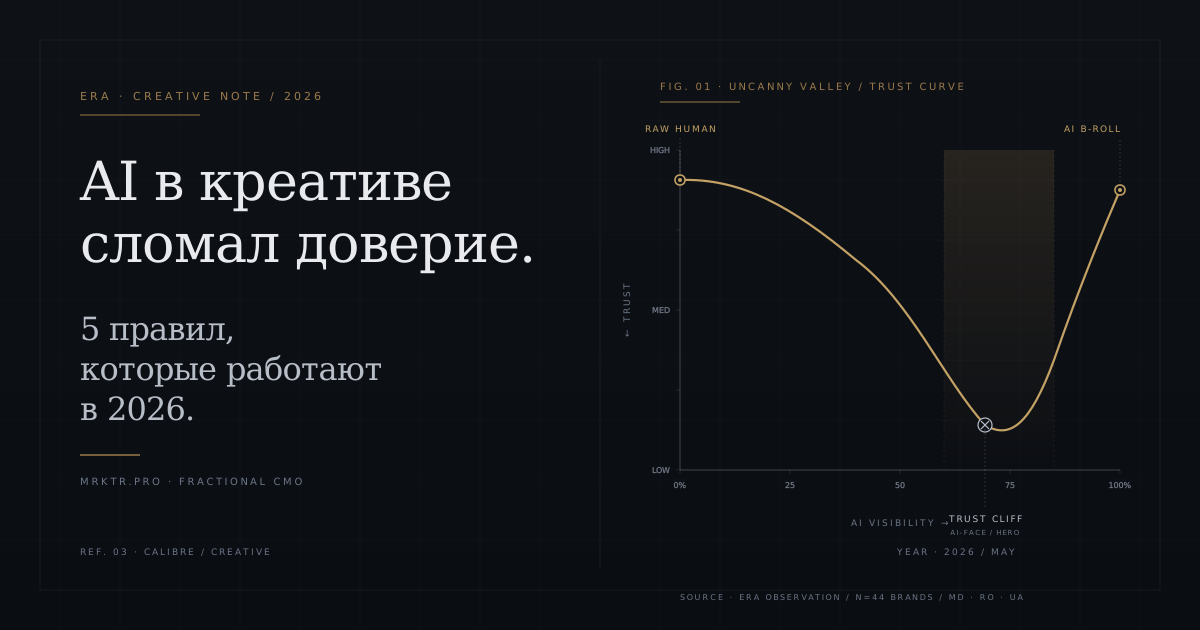
The failure mechanic is always the same. AI lands in the lifestyle hero — the frame that sells not product but brand identity. Audiences expect to see a person in that frame whose decision they can read in real time: gesture, gaze, imperfect posture. AI can't do that yet. Sora 2, Runway Gen-4.5, Midjourney V8.1 — all of them are excellent at abstract motion, texture, product photography, and all of them fail on second-pass comparison with raw human content in the same feed.
This is not about model quality. It's the uncanny valley in a social context. TikTok trained audiences on raw — handheld, available light, native-aspect, ungraded. When an AI-polished face drops into that feed, it doesn't read as "premium," it reads as "the brand cut humans from the budget." Instagram in Q1 2026 officially named this "The Year of Raw Content" and rebuilt ranking around unpolished material ([Don Creative Group](https://doncreativegroup.com/trends-and-news/instagrams-raw-content-revolution-major-platform-updates/)).
For a €500K–5M brand, the implication is simple: an AI-face in the lifestyle hero is the new category tell, signaling "mass market, cutting production costs." Exactly the opposite of what the cost-conscious founder wanted.
Where AI works brilliantly
The trust line is clean, and it isn't "AI or no AI." It's where in the production chain.
**B-roll and transitions.** Runway Gen-4.5 on the Pro plan ($35/month, 2,250 credits) yields about 90 finished 10-second clips per month at an average of 4–6 iterations per usable cut ([Runway pricing](https://runwayml.com/pricing)). For a HoReCa brand, that's steam rising off coffee, slow-motion bread being cut, abstract kitchen ambience, light pouring through a window. No one has ever complained about AI-generated espresso steam. No one has ever praised it either — it works the way B-roll is supposed to work.
**Color grading and asset variation.** AdCreative.ai on Pro ($249/month) produces 30+ platform-native cuts from one master asset. This isn't creative in the bottom-up-idea sense — it's creative operations capacity, exactly the work a motion designer did for €1.8K/month in 2022. For a DTC brand testing 12 hooks × 4 creatives × 3 platforms, it's the difference between 6 weeks and 6 days.
**Voice scaling through ElevenLabs Pro ($99/month, 500K credits).** The founder records 30 minutes of clean speech once, and from then on every Reel, audiogram, podcast intro, customer-onboarding voicemail is generated in their own voice. This converts a single-founder brand's scarcest resource — founder time — into infinite distribution. The ethical envelope is narrow: don't fabricate new founder opinions, don't fake a live event. Inside that envelope, it's one of the highest-ROI tools of 2026.
**Product effects on TikTok.** Formats like Floating Product, AI Squish, Ghibli transformation (155M+ videos on TikTok) work precisely because they don't try to be people ([Vidguru](https://www.vidguru.ai/blog/2026-top6-video-effects.html)). Explicitly conditional, explicitly stylized, explicitly AI — and the audience doesn't feel duped.
The canonical 2026 reference: Bottega Veneta. Summer 2026 campaign shot by Juergen Teller in Venice on natural light, real human faces, location production budget north of €500K. Fall 2026 campaign by Chris Rhodes — "terrazzo flooring, tile backsplashes, vintage wallpaper, and rain-soaked asphalt" ([V Magazine](https://vmagazine.com/article/the-bottega-veneta-fall-2026-campaign-explores-venice/)). AI is in there — in post, in color, in texture enhancement. AI is not in there — not in faces, not in places, not in materials. Burberry under Daniel Lee in Spring 2026 ("festival grit") — same playbook: real mud, real bristle on the fabric, AI in the final color story.
The rule that falls out: AI is an infrastructure layer, not a representation layer. ERA frames it for clients as the 80/20 Workshop/Showroom rule ([Artisan Creatives](https://artisancreatives.org/the-perfection-trap.html)). 20% polished Showroom for the site and flagship paid placements, where AI can show up at the assist level. 80% raw Workshop, where AI doesn't belong at all, because raw means "we shot this ourselves, in a real place, with a real person." This formula isn't about aesthetics. It's about the brand's trust budget, which currently trades on the attention exchange.
Rule 1. AI face boundary
**Never in hero / lifestyle. Fine in abstract motion / B-roll.**
This is the hardest rule of 2026, and the one most often broken, because the cost of breaking it isn't visible immediately. The hero shot sells identity: the founder, the customer, hand on product, eye contact with the camera. No AI-face there, in any form. Not with a disclaimer, not as "stylization," not as a "temporary fix until we shoot."
Fine for AI: abstract motion (light on water, fabric in the wind, steam over a cup), B-roll (cityscape as transition, natural elements), product effects (floating, squish, transformation), background plates for compositing a real performer. Color grading, upscaling, texture enhancement in post are already standard industry practice; audiences don't distinguish them.
The single-question check for a founder: "If tomorrow a competitor with a €500K+ budget shoots the same scene with a real person in a real place — does your AI version read as a reasonable alternative, or as cost-cutting?" If the second, don't do it. Better to spend the face budget once a quarter on a real human than 12 times a year on AI that reads as mass market.
Gucci, Valentino, H&M in 2024–2025 paid the tuition on this rule for everyone. The brands that win next are the ones who apply it.
Rule 2. 80/20 Workshop/Showroom
**80% raw founder content, 20% polished campaign.**
In May 2026, Instagram leadership publicly rebuilt ranking around raw content — handheld, available light, native-aspect, ungraded ([Don Creative Group](https://doncreativegroup.com/trends-and-news/instagrams-raw-content-revolution-major-platform-updates/)). The algorithm structurally suppresses overproduced content. That's math, not taste.
Operating form of the rule: **12–20 raw clips per month + 1 cinematic spot per quarter**. Raw is made by the founder or one staff member, on a phone, 60–90 seconds, unscripted. Cinematic is a quarterly €4–12K shoot with a local DOP (Bucharest, Kyiv, Chișinău — all three markets have independent DOPs in this price range). The ratio cannot be reversed. A brand that ships one polished spot per month and zero raw is invisible in feed in 2026 by pure ranking math.
If a founder isn't willing to be on camera weekly, that isn't a "content problem." It's structural debt for the brand. Either you find an alternative visible operator (head of brand, head of product, lead artisan), or the brand accepts a plateau in its category. This problem isn't solved by an agency. Reference creators — Lia (@thefashionarchitect), Sophia Roe, Eloïse Hagège — scale exactly the work a founder does in an hour, not in €4K.
Rule 3. Place photography
**Bessarabia, the Carpathians, RAK dunes — your unfair advantage.**
Bottega Veneta shoots in Venice, Loro Piana in its own mill, Aesop in Melbourne. Premium 2026 = "we'll show you the exact place this was made." Not visual styling-as-Italy — literally that Italy, that tile, that wet pavement.
A €500K–5M brand in our markets has what Bottega buys for €500K+: the Bessarabian limestone cellars of Cricova and Mileștii Mici, the Carpathian foothills, post-Soviet brutalist Chișinău, the artisan quarter of Lviv, the dunes near Ras Al Khaimah. This is not an "alternative" to an Italian palazzo — it's a more visually distinctive material, because no one in the category has worked it yet.
Operating rule: photograph in the place where the product is **made, used, or aged**. Wine in the cellar, not on a cyclorama. HoReCa in the kitchen and the dining room before opening, not in a studio. Skincare at the client's bathroom in morning light, not in a beige studio box. One big place-shoot per year with a local DOP, then four quarters of content well off those assets.
AI cityscapes and generic stock are category tell #2 right after the AI-face. A beige cyclorama product on a beige background in 2026 unambiguously signals mass market. Premium looks like real tile, real moisture, real dust.
Rule 4. System, not logo
**Typography, motion system, sound design — not "the same logo you've had for 5 years."**
The logo as a deliverable is a 2010s artifact. In 2026 a meaningful identity project looks like this:
one custom or licensed display typeface (GT Sectra, Canela, Freight Display, or Mutant Heritage — Bodoni / Caslon with distressed variants);
one utility sans (Inter tier) for UI and body;
one wildcard (handwritten, monospace, distressed) for voice moments;
a kinetic specification — how the logo and headlines behave on scroll, hover, audio;
a sonic palette — a 6-hour ambient mix for retail, a brand voiceover guide, a founder voice clone through ElevenLabs;
a packaging system on mono-material with refill architecture.
This costs 1.5–2× more than "just refresh the logo" and lasts 4× longer. Regional studios that can deliver at international standards — VRLN Studio, Armeanu Creative Studio, Toud in Bucharest; Reform Collective out of Ukraine; in Moldova premium brands still import this work from Bucharest or Kyiv ([VRLN Studio](https://www.vrln.studio/), [Reform Collective](https://www.reformcollective.com/)).
Glossier, Mailchimp, Spotify (under COLLINS) — all of them work as systems. Their logos are recognizable, but the logo alone doesn't carry identity weight — typography, motion, sound, packaging, and voice carry it. A €1–5M brand that briefs "refresh the logo" is usually solving the wrong problem.
Rule 5. Narrow positioning
**While the category shifts — narrow. Expand only on signal.**
With AI flattening the average brand into boilerplate ("premium + sustainable + community-first"), the only escape velocity is narrow-but-deep. Owen Hims started with hair loss only. Liquid Death — "canned water for people who hate hydration content." Sellers Dorsey — Medicaid consulting and nothing else. Bevza — "less and luxe" as one lens. Meze Audio — premium headphones as a single category, no extensions.
The discipline is brutal: cut the SKU range, cut the audience, name the enemy, double the depth in one vertical. For a HoReCa brand in Iași it might mean — not "a restaurant for everyone," but "the only place in the city for late-dinner Sunday with kids under 6." For a €500K skincare brand — not "anti-aging," but "post-procedure recovery for women 35–50 in Eastern Europe." This isn't narrowing for aesthetics — it's narrowing for mental availability (Byron Sharp): when the category triggers in-market, the brand has to be one name in the head, not one of ten.
When to expand. Three signals that the narrow strategy has done its work and you can widen the aperture:
**Search volume +30%** YoY on the brand name in Google Trends — the category started associating with the brand.
**Repeat rate on the core product >50%** over six months — the product retains, so a line extension is supportable.
**Unaided brand recall in TAM >15%** on a slope survey — there's mental availability to expand into.
Miss all three and expansion is premature. Glossier shipped Body and You only after the core skincare line hit those metrics. Liquid Death moved into tea only after the water line had taken category leadership.
A founder who narrows positioning loses 20–30% of audience up front and gains 3× compound growth over two years. A founder who stays "approachable to everyone" optimizes for a local maximum and plateaus at €1.5–2M.
Close
The five rules of 2026 aren't a brand book. They're operational discipline that keeps a €500K–5M brand out of three failure modes: trust loss through the AI-face in hero, reach loss through over-polished content, identity loss through generic studio photography.
ERA hands these rules to clients in the first 30 days of an engagement, not the first six months. Not because they're "trending in 2026" — because they neutralize structural risk most brands in Moldova, Romania, and Ukraine don't see coming until they've burned €15–40K on creative that doesn't work.
If you have a specific case — HoReCa in Chișinău, €1M skincare in Kyiv, a winery in Purcari, a premium service brand in Bucharest, an export concept in Dubai — the diagnostic runs in a 60-minute call. Output: a diagnostic with channel audit, attribution gap, creative-fatigue analysis, and a 90-day priority sequence. After the call, the founder decides in 48 hours whether to keep going.
[mrktr.pro](https://mrktr.pro) → diagnostic.
— ERA, fractional CMO
Key Takeaways
- 01By 2026, 52% of TikTok and Reels content contains an AI element, but ubiquity isn't acceptance — audiences flag an AI-face in three seconds.
- 02Rule #1: never AI in hero/lifestyle (founder, customer, eye contact). Fine in abstract motion, B-roll, product effects.
- 03Rule #2: 80% raw founder content on phone + 20% polished campaign per quarter. Reverse the ratio and you're invisible in feed.
- 04Rule #3: shoot in real places — Cricova cellars, Carpathians, RAK dunes — that's the unfair advantage over Italian palazzo.
- 05Rule #4: a 2026 identity project is typography + motion + sonic + packaging, not 'refresh the logo.'
- 06Rule #5: narrow-but-deep positioning. Glossier, Liquid Death, Bevza all started with one lens.
- 07AI is an infrastructure layer (B-roll, color, voice clone), not a representation layer (faces, places, materials).
Read also