Marketing Without a Full-Time Director: The External CMO + AI Analytics Model
Small and mid-sized companies usually run marketing in one of three configurations — and all three are problematic. Either there is no marketing at all and sales run on word of mouth. Or there are executors — a paid-ads specialist, an SMM contractor, a web vendor — but no one accountable for the picture as a whole. Or the owner performs the marketing director's role personally, in the evenings. Here is how the External CMO model works — and why an AI dashboard has closed its main historical risk.
How the External CMO model works
An External CMO (fractional CMO in developed markets) is neither an agency nor a freelancer. It is the marketing director function purchased in the required dose: several days a month of strategic and managerial work instead of a full-time position.
The scope of responsibility matches an in-house director's. Strategy and priorities — where the marketing budget goes and why, what we do this quarter and what we deliberately do not. Managing executors, in-house and external: setting tasks, controlling quality, replacing weak links. The economics of marketing — acquisition cost by channel, return on spend, the link between marketing expenditure and revenue rather than likes. And reporting to the owner — in the language of money, not reach.
The difference from a full-time hire is in the economics and the pattern library: an External CMO runs several businesses and transfers working practices between them, and the company pays for the function's output rather than for a person's presence in the office.
The marketing director function: monthly cost benchmarks
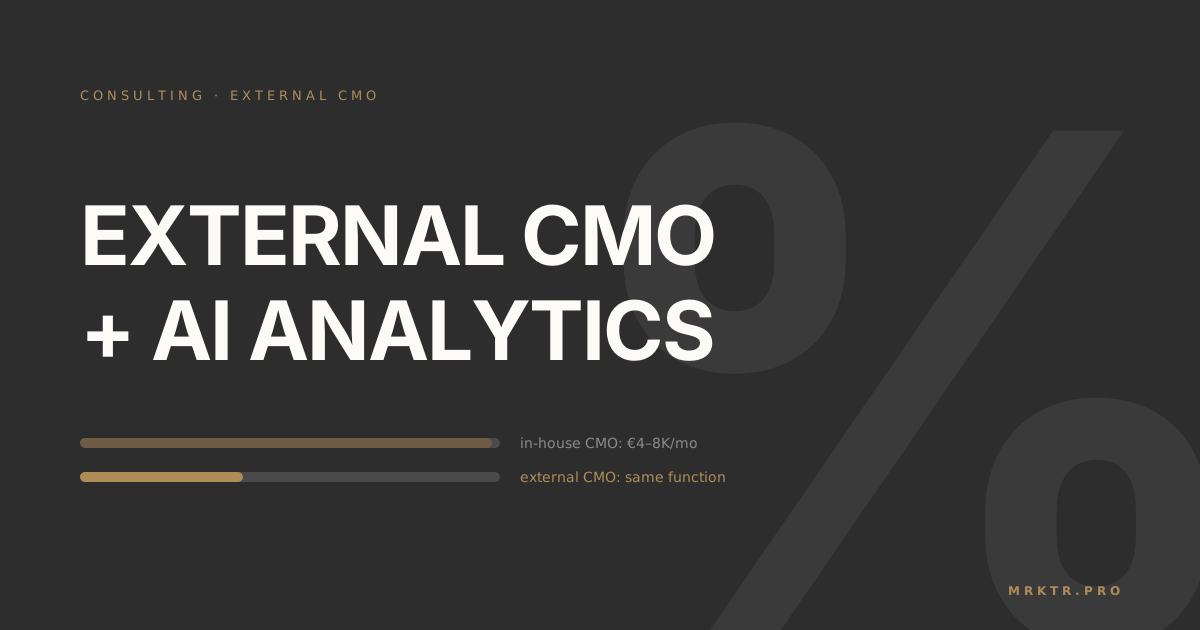
Benchmarks for Moldova, Romania and Eastern Europe; on Western markets the absolute figures are higher, the proportion is the same: the external model costs 30–50% of a full-time hire at a comparable level of specialist.
The model's Achilles heel — and how AI closed it
Honestly, about the model's main historical risk: transparency. When the marketing director sits outside the office, the owner has a legitimate question — how do I see that the work is happening and producing results? The old answer was monthly presentations, which is the same manual reporting with all of its delays and interpretations.
Today that gap closes technologically. The pairing of External CMO plus AI dashboard means the owner and the marketing director look at the same screen of live data: channels, cost per inquiry, revenue dynamics, anomalies. Not once a month at a meeting — every day, from a phone.
This changes the nature of the relationship itself. The External CMO stops being someone who has to be taken at their word — the work is continuously visible in the numbers. And meetings with the owner are freed from retelling reports and devoted to decisions. To see what such a shared screen looks like, open the owner dashboard demo: mrktr.pro/owner-intelligence.
What AI changed inside the marketing work itself
In parallel, AI has rebuilt the execution layer of marketing. Content production, platform adaptations, campaign drafts — faster and cheaper. But this sharpened rather than removed the need for the managing function: when anyone can produce, competition shifts to whoever decides what to produce and why.
So, paradoxically, the AI era raised the value of the CMO function specifically — judgment, priorities, strategy — and lowered the value of pure execution. For a small company this is good news: execution got cheaper, and judgment can now be bought in a sensible dose without hiring someone full time.
Who the model fits, and who it does not
An External CMO is a working solution when three conditions hold. The company already has a product and sales — there is something for the marketing management function to work with. The company spends meaningful money on marketing without understanding the return — there is something to optimise. And the owner is prepared to delegate — that is, to give the function real authority rather than hiring an advisor with no vote.
The model does not fit if there is no marketing budget at all — there is nothing to manage yet, and an honest External CMO will say so at the first meeting. Nor does it fit an owner expecting a miracle worker on a one-month horizon: a management function produces its effect over quarters, not weeks.
Key Takeaways
- 01An External CMO is the marketing director function in the required dose: strategy, managing executors, marketing economics and reporting in the language of money.
- 02On cost, the model runs at 30–50% of a full-time hire; for Moldova and Romania the benchmark is €2 000–3 000 a month against €4 000–8 000+ for staff.
- 03The model's main historical risk — transparency — is closed by pairing it with an AI dashboard: the owner and the CMO look at the same screen of live data every day.
- 04AI made execution cheap and raised the value of judgment: deciding what to produce and why has become the main competition in marketing.
- 05The model fits a business with a product, sales and a budget without visibility into returns; it does not fit a zero budget or the expectation of a miracle within a month.
Read also